
Group Managing Director, Alfa Designs Nigeria Ltd., Mr Quadri Fatai, has called on regulators to mandate the installation of advanced gas-leak detection cameras across all Compressed Natural Gas (CNG) and Liquefied Petroleum Gas (LPG) facilities in the country.He made the call in a media conversation during the 10th Sub-Saharan Africa International Petroleum Exhibition and Conference (SAIPEC) in Lagos.Fatai, also the Chief Executive Officer of the oil and gas company, said this would help to prevent explosions and improve public safety. He warned that undetected gas leaks remained one of the most serious safety risks in the downstream gas value chain, noting that many recent gas-related incidents could have been avoided with early-warning systems.According to Fatai, regulators can compile a comprehensive register of all CNG and LPG operators and require each facility to deploy advanced optical gas-imaging cameras, such as the “Eye-C Gas 2.0”, capable of detecting invisible gas leaks in real time.Fatai said, “We must move from reactive safety measures to proactive prevention.“Gas leaks are often invisible to the naked eye. You don’t see them, you don’t smell them early enough, and by the time they are detected, it is often too late.”Continue he explained that the Eye-C Gas 2.0 camera enables operators to visually identify leaks instantly, isolate the source and take corrective action before fires, explosions or environmental damage occur.Fatai said the technology provides continuous monitoring of pipelines, valves, flanges and storage facilities, making it critical for high-risk locations such as gas processing plants, filling stations, transport depots and industrial sites.As Nigeria embraces gas adoption for transportation and domestic use, he explained that safety standards must evolve at the same pace.“The gas revolution must be matched with a safety revolution.“Promoting gas for cleaner energy and economic growth without strong safeguards puts communities, workers and investments at risk,” he said.Fatai described the cost of deploying detection cameras as minimal when compared with the human and economic losses associated with gas explosions.“Lives lost, facilities destroyed and businesses shut down cost far more than investing in preventive technology,” he noted.He urged regulators to integrate gas-leak imaging systems into licensing and renewal requirements, alongside routine safety audits, stressing that compliance should be mandatory.“This should not be optional. It should be a standard requirement for operating any CNG or LPG facility in Nigeria,” he said.Fatai reaffirmed the commitment of the company to supporting safer energy infrastructure through innovation, training and technology deployment.The Alfa boss noted that the company had trained more than 50 Nigerian graduates across four geopolitical zones on gas-leak detection technology.He said strengthening safety standards would not only save lives but also boost investor confidence and create skilled jobs for young Nigerians.“If we get safety right, we protect lives, attract investment and build public confidence in gas as a sustainable energy solution,” he said.On SAIPEC, Fatai commended the Petroleum Technology Association of Nigeria (PETAN) for sustainfing the conference over the past decade.He maintained that the platform remained critical for collaboration, capacity building and practical solutions in Africa’s energy industry.He said SAIPEC had grown into a premier networking hub that connects indigenous companies with global opportunities, promotes local content development and translates dialogue into tangible projects.Also speaking, Mr Michael Tsudikov, Sales Director of Opgal Industries, said the Eye-C Gas camera is capable of detecting methane, hydrocarbons, more than 400 volatile organic compounds (VOCs) and carbon dioxide.
Experts seek mandatory gas-leak cameras for CNG, LPG facilities
by  Emeka Moses
Emeka Moses 



Latest from News

The Person on the Other End of the Line
This Customer Service Week, the extra mile starts with something simpler: making sure that when a customer, caller, or visitor needs a human being, one is there. By Olufunmilola ‘Funmie’ Aluko | Customer Experience Leader | Chief Brand and Marketing Officer/ Head,
Interswitch TechConnect 6.0 Drives Cross-Country Conversation on the Future of Financial Infrastructure
Interswitch, one of Africa’s leading integrated payments and digital commerce companies, is taking the sixth edition of its TechConnect industry engagement series across four Nigerian cities. The series brings together leaders and stakeholders from government, financial services, technology and business to examine
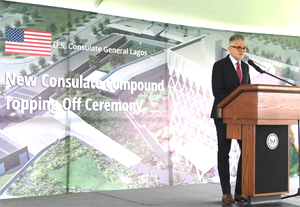
U.S. Celebrates Key Construction Milestone at New Consulate Compound in Eko Atlantic City
Photo 001: U.S. Deputy Assistant Secretary of State for West Africa and for Public Diplomacy Richard Michaels delivering remarks at the Topping Off Ceremony of the New Consulate Compound at Eko Atlantic City in Lagos. Photo 002: (L-R): U.S. Consul General Brandon

No Customers, No Brand! – John Kokome
In business, a dangerous illusion is that companies build brands on their own. They choose the name, design the logo, create the campaign, buy the media space and announce to the world what they stand for. But the market has the final

KILLINGS: More than 1,000 northern Islamic clerics tell Tinubu
Over 1,000 northern Islamic clerics have told President Bola Tinubu to drop his 2027 re-election ambition, citing killings, kidnappings and acts of terrorism across the country, particularly in the North-West. The demand was contained in a communique issued at the end of