
ActionAid Nigeria and other stakeholders have faulted the proposed N1.45 trillion allocation to the Federal Ministry of Agriculture and Food Security (FMAF) in the 2026 budget.The stakeholders include the Smallscale Women Farmers Organisation in Nigeria (SWOFON), the Community of Agriculture Non-State Actors (COANSA), and Young Farmers in Nigeria (YoFiN).They made their position known at a news conference in Abuja on Tuesday while presenting an analysis of the Federal Government’s proposed 2026 agriculture budget.The conference reviewed funding priorities under the National Agrifood Systems Investment Plan (NASIP 2025–2027) and the National Agricultural Technology and Innovation Policy (NATIP 2022–2027).It also reflected recommendations from the National Stakeholders Consultative Meeting on the 2026 agriculture budget.The stakeholders recommended that the National Agricultural Development Fund (NADF) be granted first-line charge status and included as a statutory allocation to enable it effectively fulfil its mandate.The joint presentation was delivered by Mrs Wakilat Okeji of SWOFON, Gift Adamu of YoFiN, and Mr Tosin Zuberu and Dr Gbenga Arokoyo of COANSA.Okeji said the 2026 Appropriation Bill proposed N1.45 trillion for the FMAF, representing 2.48 per cent of the total proposed N58.47 trillion national budget.She said that when combined with the allocation to the Ministry of Livestock Development, the agriculture sector’s share rises slightly to 2.59 per cent.According to her, this represents a decline compared to 2025 when the agriculture sector accounted for 4.62 per cent of the federal budget.“The reduction is reflected in overall planned expenditures to MDAs within NASIP and NATIP programme areas, whose total allocation declined by 15.26 per cent from N10.497 trillion in 2025 to N8.896 trillion in the 2026 proposal,” she said.Arokoyo also recommended that the National Agricultural Development Fund be granted first-line charge status and included as a statutory allocation.He said the fund’s current allocation of N94.14 billion, representing 99.46 per cent of its total budget, raises concerns about fiscal balance, sectoral equity, and strategic impact.Arokoyo noted that N89.09 billion of the allocation is concentrated in a single project, the Renewed Hope Fertiliser Support Programme (RH-FSP).“While fertiliser support is important, such disproportionate spending on one input risks undermining the broader Renewed Hope Agenda and fails to address structural constraints facing smallholder farmers,” he said.He recommended reducing the allocation to the RH-FSP to N10 billion and redirecting the remaining funds to other critical areas with broader impact.These include improving access to affordable credit, targeted support for women and youth farmers, scaling labour-saving technologies, expanding access to diverse farm inputs, and reducing post-harvest losses.Other priority areas include investment in processing and storage facilities, farmer training programmes, improved market access, and strengthened agricultural extension services.Arokoyo also called for increased investment in irrigation development and Climate Resilient Sustainable Agriculture (CRSA), also known as agroecology.He noted that CRSA was essential for building resilience against climate shocks and ensuring long-term food security.
ActionAid, others urge improved funding structure for agric sector
by  Emeka Moses
Emeka Moses 

Latest from News

The Person on the Other End of the Line
This Customer Service Week, the extra mile starts with something simpler: making sure that when a customer, caller, or visitor needs a human being, one is there. By Olufunmilola ‘Funmie’ Aluko | Customer Experience Leader | Chief Brand and Marketing Officer/ Head,
Interswitch TechConnect 6.0 Drives Cross-Country Conversation on the Future of Financial Infrastructure
Interswitch, one of Africa’s leading integrated payments and digital commerce companies, is taking the sixth edition of its TechConnect industry engagement series across four Nigerian cities. The series brings together leaders and stakeholders from government, financial services, technology and business to examine
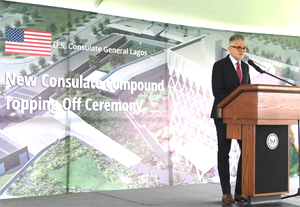
U.S. Celebrates Key Construction Milestone at New Consulate Compound in Eko Atlantic City
Photo 001: U.S. Deputy Assistant Secretary of State for West Africa and for Public Diplomacy Richard Michaels delivering remarks at the Topping Off Ceremony of the New Consulate Compound at Eko Atlantic City in Lagos. Photo 002: (L-R): U.S. Consul General Brandon

No Customers, No Brand! – John Kokome
In business, a dangerous illusion is that companies build brands on their own. They choose the name, design the logo, create the campaign, buy the media space and announce to the world what they stand for. But the market has the final

KILLINGS: More than 1,000 northern Islamic clerics tell Tinubu
Over 1,000 northern Islamic clerics have told President Bola Tinubu to drop his 2027 re-election ambition, citing killings, kidnappings and acts of terrorism across the country, particularly in the North-West. The demand was contained in a communique issued at the end of