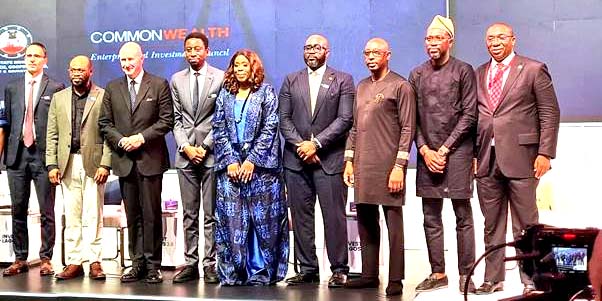
Interswitch Group, Africa’s first homegrown technology unicorn and the continent’s foremost digital payments infrastructure company, participated as AI and Innovation Pavilion co-chair and corporate thought-leader at the 3rd Invest in Lagos Summit, held at the Eko Hotels & Suites, Victoria Island, Lagos, from June 8–9, 2026.
The high-profile summit, convened under the auspices of the Lagos State Government and themed ‘Lagos: Business Gateway to Africa’ expectedly drew a distinguished gathering of public and private sector leaders from across Africa and the global investment community, including His Excellency Senator Kashim Shettima, Vice-President of the Federal Republic of Nigeria, His Excellency Mr. Babajide Sanwo-Olu, Executive Governor of Lagos State, and a slew of other state governors from across Nigeria, as well as members of the Federal Executive Council, whose presence underscored the strategic importance of the summit as a platform for shaping Africa’s investment and innovation agenda.
Representing Interswitch Group on the summit’s flagship technology panel on day 1, themed “The Future of Technology and Innovation” was Babafemi Ogungbamila, Executive Vice-President (EVP) for Operations and Technology. Speaking to an audience of investors, policymakers, entrepreneurs, and global business leaders, Ogungbamila drew on Interswitch’s foundational story to deliver what became one of the session’s most cited contributions: a frank, first-hand account of what it truly takes to build technology infrastructure in Africa; not in theory, but from the ground up, against the odds, and before the market was ready to reward the effort.
“Without the right rails, even the best products will stall before reaching scale,” Ogungbamila asserted. “We built Nigeria’s first successful digital interbank transaction infrastructure in 2002. Nobody was asking us to build it. There was no guaranteed return. But we understood that the companies that build the foundational layer of an ecosystem don’t just compete in that ecosystem; they shape it. That principle holds as powerfully today as it did then.”
His contribution to the panel was rooted in a founding narrative that remains as instructive today as it was defining in 2002. When Interswitch was established in Lagos by Founder and Group CEO Mitchell Elegbe, there was essentially no technology ecosystem to speak of. No digital payments infrastructure. No interoperability between financial institutions. No playbook from which to build. According to him, what Lagos offered instead was something more powerful than infrastructure: a market whose economic ambition had already outpaced its digital capacity – a gap that became Interswitch’s founding mandate.
“In 2002, there was no ecosystem” Ogungbamila reflected. “No blueprint. No guarantee that what we were building would find a market. Just a sprawling, complex, commercially ferocious city whose economy was moving faster than its digital infrastructure could carry. That gap was our invitation.”
That invitation produced Nigeria’s first interoperable digital payments switching infrastructure, the invisible backbone that today processes the majority of Nigeria’s electronic transactions and connects banks, merchants, fintechs, and consumers across the country’s financial ecosystem at scale.
Speaking to the broader question of what conditions are required to scale African technology companies into globally competitive enterprises, Ogungbamila was emphatic that infrastructure depth, and the institutional courage to invest in it before the market offers its reward, remains the defining variable separating technology companies that endure from those that plateau.
“The companies that build the foundational layer of an ecosystem don’t just compete in that ecosystem, they shape it” he reiterated. “Twenty-three years on, that principle is not nostalgia. It is our operating philosophy, and it is more relevant now than ever, as Lagos cements its place as one of Africa’s foremost technology and innovation hubs, and as the next generation of African builders constructs what comes next.”
Ogungbamila further referenced The Lagos Smart Health Information Platform, known as Lagos SHIP or LAGSHIP as a first-of-its-kind initiative developed by Digital Health Platform Limited, a Special Purpose Vehicle comprising the Lagos State Ministry of Health and Interswitch eClat, designed to digitize and integrate patients’ health records across the state into a single, comprehensive platform, enabling a robust Health Information Exchange system that gives healthcare providers real-time access to comprehensive patient records for more informed decision-making, while simultaneously empowering patients with unprecedented control over their personal health data. Beyond individual patient care, LAGSHIP eliminates the inefficiencies of manual data handling, ensures data confidentiality and privacy, and equips the Lagos State Government with the data intelligence needed to plan and coordinate healthcare services across all levels, from primary healthcare centres to tertiary institutions. This essentially transforms fragmented, error-prone record management into a unified, policy-grade infrastructure for a city of over 22 million people
Such an intervention, which essentially seeks to replicate in healthcare, how technology was leveraged by Interswitch, based on infrastructure-thinking, to transform banking and payments (resulting in tremendous multiplier effects) about 2 decades ago, speaks to forward-thinking vision by the leadership of Lagos State.
Ogungbamila further addressed the conditions required to drive inclusive, broad-based economic growth through technology, arguing that connectivity must be treated as constitutional infrastructure, that public-private partnerships must be designed around community need rather than commercial convenience, and that regulatory frameworks must be built to enable innovation rather than merely govern it. On artificial intelligence specifically, he called for African governments to invest in regulatory capacity before regulatory complexity highlighting that understanding must precede legislation if Africa is to capture the full economic value of the AI revolution.